







The landscape of search engine optimization has fundamentally transformed. Gone are the days when keyword stuffing and basic link building could propel your website to the top of search results. Today, artificial intelligence in SEO has revolutionized how search engines understand, rank, and present content to users.
With Google processing 8.5 billion searches daily and implementing AI-powered features like AI Overviews in 13.14% of all queries, understanding AI and SEO has become non-negotiable for digital marketers. This comprehensive guide explores how artificial intelligence is reshaping search engine optimization and provides actionable strategies to help your business thrive in this AI-driven landscape.
In This Guide
Jump to any section:
- What is AI in SEO?
- How AI Has Changed Search in 2026
- Google AI Overviews: What They Are and How to Appear in Them
- AI Search Platforms: ChatGPT, Perplexity, and Gemini
- How Has Artificial Intelligence Changed Search Marketing?
- Why AI SEO Matters More Than Ever
- The Role of Artificial Intelligence in SEO
- Optimizing for Google’s AI Features: SGE and AI Overviews
- Will AI Replace SEO? Understanding the Future
- Application of AI in SEO: Practical Implementation Strategies
- AI SEO Tools: A Practical Walkthrough
- AI for Technical SEO Automation
- How to Build an AI SEO Workflow for Your Business
- AI SEO for Indian Businesses in 2026
- Statistics Highlighting AI’s Impact on SEO
- Future Trends in AI SEO: What’s Coming Next
- Case Study: How AI SEO Optimization Transformed Results
- Conclusion: Embracing AI in SEO for Future Success
- Frequently Asked Questions About AI in SEO
What is AI in SEO?
AI in SEO (Artificial Intelligence in Search Engine Optimization) refers to the integration of machine learning algorithms, natural language processing (NLP), and large language models into search optimization strategies. This AI-powered SEO approach enhances and automates critical SEO components including keyword research, content creation, on-page optimization, technical SEO analysis, and performance monitoring.
Unlike traditional SEO methods that rely on reactive strategies, AI SEO optimization enables predictive analysis, real-time data processing, and continuous optimization that adapts to both search engine algorithm updates and evolving user behavior patterns.
How AI Has Changed Search in 2026
The AI search landscape has shifted more in the past 18 months than in the previous decade. Here is what has actually changed, and why it matters for your SEO strategy today.
The numbers that define 2026 search
- Google AI Overviews now appear in more than 50 percent of all Google searches as of Q1 2026
- ChatGPT reached 800 million weekly active users by October 2025, doubling from 400 million in February 2025
- AI-referred traffic to websites grew 527 percent year on year in the first five months of 2025
- Google’s share of the search market dropped below 90 percent for the first time since 2015
- AI adoption among internet users jumped from 14 percent to 29.2 percent in just six months
What this means practically is that SEO in 2026 is no longer just about ranking in ten blue links. You are now competing to be one of two to five sources that an AI system trusts enough to cite in a generated answer. If your content is not cited, you do not exist for that query in that AI system.
Traditional SEO optimised for clicks. AI SEO optimises for citation, trust, and topical authority across both Google and AI platforms. The businesses that understand this shift now are the ones that will own their categories in search over the next three years.
Google AI Overviews: What They Are and How to Appear in Them
Google AI Overviews (previously called Search Generative Experience or SGE) are AI-generated summary answers that appear at the top of Google search results, above the traditional blue links. As of Q1 2026, they appear in more than 50 percent of all Google searches.
For SEO professionals and business owners, AI Overviews represent both a risk and an opportunity. The risk: if your content is not cited in the Overview, your organic traffic for that query drops significantly even if you rank in the top three. The opportunity: if your content is cited, you receive visibility at the very top of the page – above position one.
What triggers an AI Overview
- Informational queries with a clear answer (how, what, why, explain)
- Comparison and best-of queries
- Step-by-step how-to questions
- Topics with multiple sub-questions bundled into one search
How to optimise your content to appear in AI Overviews
- Write clear, direct answers at the start of each section – AI systems pull concise definitions and summaries first
- Use structured content: H2 and H3 headings that match the questions people are searching
- Add FAQ sections – Google frequently pulls FAQ content into AI Overviews
- Strengthen E-E-A-T signals: named authors, credentials, and first-hand examples make your content more trustworthy to AI systems
- Use schema markup: Article, FAQ, and HowTo schema all help AI systems understand and categorise your content
- Cite authoritative sources: AI Overviews preferentially feature content that links to credible external references
One important note: appearing in an AI Overview does not require ranking in position one. Pages ranked between positions two and ten are regularly cited in Overviews. Content quality and structure matter more than raw ranking position for AI Overview inclusion.
AI Search Platforms: ChatGPT, Perplexity, and Gemini
Google is no longer the only search platform that matters. In 2026, a growing share of search behaviour is happening directly inside AI platforms – and your SEO strategy needs to account for all of them.
ChatGPT
ChatGPT reached 800 million weekly active users by October 2025. Users are now using it as a primary research and discovery tool, asking it questions they would previously have typed into Google. ChatGPT with web browsing enabled pulls live content from the web – meaning well-structured, authoritative, frequently updated pages are more likely to be cited in its answers.
Perplexity
Perplexity is a dedicated AI search engine that generates cited answers from live web sources. It is growing fastest among technical and professional audiences. Pages that appear in Perplexity results tend to have strong topical authority, clear source attribution, and structured data. Perplexity explicitly shows which sources it pulls from – making citation visibility very direct.
Google Gemini
Gemini is Google’s AI assistant integrated directly into Search, Gmail, Workspace, and Android. Content that performs well in Google AI Overviews generally also performs well in Gemini-generated answers, since both draw from Google’s index and apply similar quality signals.
How to optimise for AI platforms
- Use clear, citation-friendly writing: state your main point in the first sentence of each section
- Include original data, statistics, and first-hand examples – AI systems prefer citable facts
- Structure content with H2 and H3 headings that match natural language questions
- Keep your content updated – AI platforms prioritise freshness for fast-moving topics
- Build brand mentions across the web – AI systems learn brand authority from how often you are referenced
How Has Artificial Intelligence Changed Search Marketing?
Artificial intelligence has permanently transformed search marketing in three fundamental ways:
1. Personalized Search Results
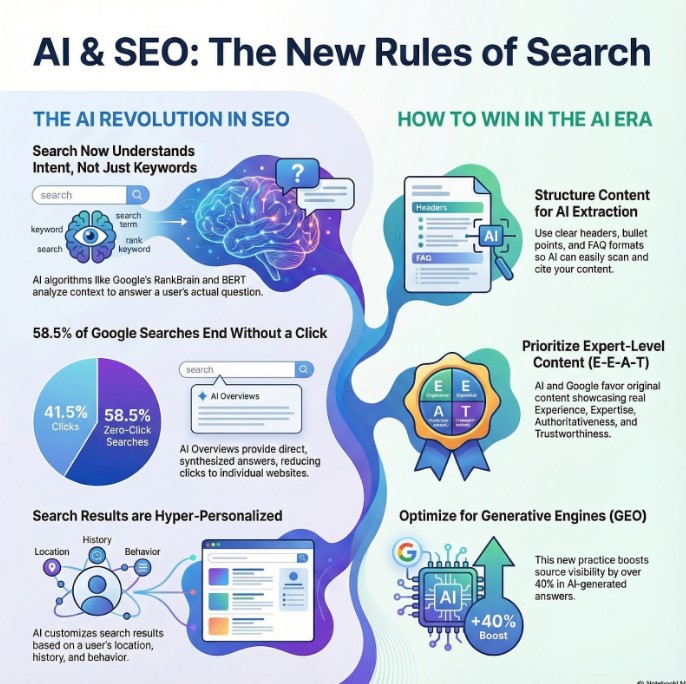
AI algorithms now deliver customized search results based on user behavior, location, device type, search history, and hundreds of other factors. This means that two users searching for the same keyword may see entirely different results based on their individual context and search intent.
2. AI-Powered Search Features
Google’s Search Generative Experience (SGE) and AI Overviews represent a paradigm shift in how search results are presented. These features provide direct, synthesized answers by analyzing multiple sources, reducing the need for users to click through multiple links. According to recent data, 58.5% of Google searches now end without a click, fundamentally changing how we measure SEO success.
3. Intent-Driven Ranking
Modern search engines use AI to understand the context and intent behind queries rather than just matching keywords. Google’s RankBrain, BERT, and MUM algorithms process natural language to deliver results that answer the searcher’s actual question, not just pages containing matching keywords.
Why AI SEO Matters More Than Ever
The integration of AI-driven SEO strategies offers several compelling advantages:
- Enhanced Data Processing: AI systems analyze millions of data points in seconds, identifying patterns and opportunities invisible to manual analysis
- Improved User Intent Recognition: Natural language processing distinguishes between various types of search intent with unprecedented accuracy
- Workflow Automation: Approximately 51% of marketers use AI tools to optimize content for SEO, freeing teams to focus on strategy and creative development
- Algorithmic Adaptation: AI systems detect subtle algorithm shifts within hours rather than weeks, enabling proactive optimization
- Cross-Platform Optimization: Modern AI SEO tools simultaneously optimize for traditional search, featured snippets, voice search, and AI-generated responses
The Role of Artificial Intelligence in SEO
AI-based SEO has expanded across every aspect of search engine optimization. Here’s how artificial intelligence is transforming each core SEO discipline:
1. AI-Powered Keyword Research and Analysis
Traditional keyword research involved manually identifying relevant keywords based on limited data sets. AI SEO tools have revolutionized this process through:
- Predictive Analysis: AI systems identify emerging search trends 4-6 weeks before they appear in conventional keyword tools by analyzing social media signals, news patterns, and search correlation data
- Semantic Clustering: Modern AI platforms group keywords by underlying intent and conceptual relationships rather than simple lexical similarity
- Intent Classification: AI goes far beyond basic informational/navigational/transactional categories, classifying dozens of nuanced intent types throughout the customer journey
- Long-Tail Discovery: AI algorithms excel at identifying specific, niche phrases with lower search volumes but significantly higher conversion rates
Google’s RankBrain, an artificial intelligence SEO tool integrated into Google’s core algorithm, helps the search engine understand user intent and context, processing over 15% of Google’s daily searches.
2. AI-Driven Content Creation and Optimization
Using AI for SEO content creation has transformed from a controversial topic to an industry standard, with proper implementation:
- Research Synthesis: AI analyzes hundreds of top-ranking pages to extract key points, statistics, and consensus viewpoints
- Competitive Content Analysis: Advanced AI tools identify content gaps, differentiation opportunities, and unique angles by analyzing competitor content at scale
- Semantic Enhancement: AI-powered tools like Clearscope and MarketMuse analyze top-performing content to identify semantically relevant terms and concepts missing from your content
- Readability Optimization: Language models can revise content for optimal sentence structure, paragraph length, and reading level based on what performs best in your niche
However, it’s crucial to combine AI efficiency with human creativity and expertise. AI-generated content should always be reviewed, enhanced, and personalized with first-hand experience and expert insights to meet Google’s E-E-A-T (Experience, Expertise, Authoritativeness, Trustworthiness) guidelines.
3. On-Page SEO Enhancement Through AI
AI-powered search engine optimization has made on-page optimization more precise and effective:
- Meta Tag Optimization: AI platforms dynamically create and optimize title tags, meta descriptions, and header tags based on real-time analysis of user behavior and search trends
- Content Structure Analysis: AI evaluates content organization, suggesting improvements to heading hierarchy, paragraph structure, and information flow
- Image Optimization: AI suggests relevant alt text, file names, and image tags infused with strategic keywords to maximize visibility in image searches
- Mobile Experience Enhancement: AI analyzes mobile user behavior to recommend layout, design, and performance improvements
4. Technical SEO Powered by AI
Artificial intelligence search engine optimization tools have transformed technical SEO from reactive problem-solving to predictive optimization:
- Pattern Recognition: Unlike rule-based crawlers, AI systems identify anomalous patterns in site structure, server response codes, and crawl behaviors that indicate underlying issues
- Predictive Impact Assessment: Advanced AI estimates the traffic and ranking impact of specific technical issues based on historical data and comparative analysis
- Schema Markup Generation: AI tools automatically generate and implement appropriate structured data based on page content and type
- Core Web Vitals Optimization: AI-powered tools continuously monitor and optimize performance metrics including Largest Contentful Paint (LCP), First Input Delay (FID), Cumulative Layout Shift (CLS), and Interaction to Next Paint (INP)
Tools like DeepCrawl and Botify use AI-powered SEO capabilities to conduct comprehensive site audits, uncovering issues like broken links, duplicate content, slow page speed, and crawlability problems.
5. AI for Link Building Strategy
AI in SEO has revolutionized link building by:
- Prospect Identification: AI analyzes millions of websites to identify relevant, high-authority link opportunities based on content relevance, domain authority, and audience alignment
- Outreach Optimization: AI predicts the success likelihood of link outreach campaigns and suggests optimal messaging strategies
- Competitor Analysis: AI identifies trends and strategies competitors use for linking, enabling more strategic link building approaches
- Quality Assessment: AI algorithms evaluate the authority and credibility of potential link partners, identifying the best content placements for backlinks
AI tools like LinkHunter and Pitchbox automate and enhance backlink AI strategies, making link acquisition more efficient and effective.
6. User Experience (UX) Optimization
AI SEO marketing extends beyond traditional ranking factors to enhance overall user experience:
- Behavioral Analysis: AI analyzes user behavior data to identify friction points, engagement patterns, and conversion barriers
- Personalized Content Recommendations: AI-powered recommendation engines tailor content suggestions based on individual user preferences, behaviors, and past interactions
- Navigation Enhancement: AI identifies optimal site structure and navigation patterns based on user flow analysis
Engagement Optimization: AI tracks and analyzes engagement metrics to suggest content improvements that increase time on site and reduce bounce rates
Optimizing for Google’s AI Features: SGE and AI Overviews
One of the most significant developments in search is Google’s Search Generative Experience (SGE) and AI Overviews. These features use generative AI to provide direct answers to complex queries by synthesizing information from multiple sources.
What is Google’s Search Generative Experience?
Google SGE combines traditional search results with AI-generated answers, providing users with immediate, relevant information without requiring clicks through multiple links. This evolution in search technology reflects the future of keyword research and SEO trends, as businesses must adapt their strategies to align with these changes.
How to Optimize for AI Overviews
To increase your chances of being cited in AI-generated responses:
1. Structure Content for AI Extraction
- Use clear, descriptive headers (H2, H3) that organize information logically
- Create standalone answer blocks at the beginning of content sections
- Implement FAQ sections with direct question-and-answer formats
- Use bullet points, numbered lists, and comparison tables for easy scanning
2. Implement Question-Based Optimization
According to BrightEdge research, pages that directly address specific queries see 31% higher citation rates in AI-generated results. Structure your content around common questions in your industry using natural, conversational language.
3. Use Authoritative Language Patterns
Phrases like “Research demonstrates that…” or “Studies show that…” signal confidence and expertise, making your content more likely to be cited by AI systems as a trustworthy source.
4. Include Statistics and Data with Clear Attribution
Incorporating well-sourced numerical data and statistics increases your content’s value and reliability. Clearly attribute figures to reputable sources to build trust with both users and AI systems.
5. Optimize for Generative Engine Optimization (GEO)
GEO focuses specifically on optimizing content to be featured in AI-generated responses. This includes:
- Creating comprehensive topic clusters that cover all aspects of a subject
- Implementing robust schema markup (Article, FAQ, HowTo, Product schemas)
- Building entity connections through structured data
- Developing first-party, expert-level content with clear credibility signals
A study by researchers from Princeton University found that implementing GEO methods boosted source visibility by over 40% in AI-generated responses.
Explore our SEO services to implement these AI-driven strategies
Will AI Replace SEO? Understanding the Future
A critical question on every digital marketer’s mind: Will SEO exist in 5 or 10 years? The answer is nuanced but encouraging.
SEO is Evolving, Not Disappearing
While artificial intelligence and SEO are becoming increasingly intertwined, SEO will continue to be a critical component of digital marketing, albeit with significant adaptations:
- Traditional methods are transforming: Simple keyword matching and link building are giving way to sophisticated AI-driven strategies focused on user intent, content quality, and semantic relevance
- The essence of SEO persists: The fundamental goal remains connecting users with the information they seek, whether through AI answers or traditional search results
- Human creativity remains essential: While AI automates repetitive tasks, human expertise, creativity, and strategic thinking are more valuable than ever for creating unique, authoritative content
Creating Synergy Between SEO and AI
The future belongs to strategies that combine AI precision with human creativity:
- AI handles data analysis and automation: AI processes vast datasets, identifies patterns, and automates routine optimization tasks
- Humans provide strategy and creativity: People develop strategic direction, create compelling narratives, and add the experiential insights that AI cannot replicate
- Together they create superior results: This partnership delivers more effective optimization than either approach could achieve alone
According to industry research, 90% of surveyed organizations plan to prioritize SEO more highly, with AI tools enabling SEO professionals to focus on strategic analysis rather than manual optimization tasks.
Application of AI in SEO: Practical Implementation Strategies
Implementing AI-powered search engine optimization effectively requires a strategic approach. Here are nine actionable strategies:
1. Prioritize Semantic Search and Structured Content
Modern search engines understand content contextually rather than through keyword matching:
- Develop comprehensive topic clusters covering all aspects of a subject
- Use natural language and conversational tone that mirrors how people communicate
- Implement consistent heading structure with H2s for main topics and H3s for subtopics
- Create information-rich tables, lists, and comparison sections
Research shows comprehensive content covering topics in-depth ranks for 68% more long-tail keywords than narrowly focused content.
2. Implement and Optimize Schema Markup
Schema markup provides explicit context to search engines and AI systems about your content’s meaning:
- Implement core schemas (Article, Product, FAQPage, HowTo, VideoObject) for appropriate page types
- Include all relevant schema properties, schema with 90%+ property completion has 43% higher impact on rich results
- Create entity connections using properties like “mentions,” “about,” and “sameAs”
- Implement nested schema structures combining multiple types
3. Target Long-Tail and Conversational Queries
Voice search and AI chatbots have made conversational optimization critical:
- Conduct AI-powered query analysis to identify exact phrasing of long-tail queries in your niche
- Create dedicated FAQ sections addressing common questions in users’ natural language
- Optimize for question cascades, the follow-up questions users typically ask after initial queries
4. Create First-Party, Expert-Level Content
Google’s E-E-A-T guidelines and AI citation preferences heavily favor original, expert content:
- Showcase first-hand experience through case studies, original research, and documented processes
- Include proprietary data and insights unavailable elsewhere
- Implement robust author credentials with relevant expertise for each topic
- Use author schema markup to verify expertise
5. Build Strategic Internal Linking
Internal linking creates semantic networks that help search engines understand topic relationships:
- Implement topic clusters with hub-and-spoke models
- Use contextually relevant anchor text that clearly communicates topic relationships
- Create reciprocal linking relationships between related content
- Link to your other relevant content like your preparing for SGE post
6. Refresh Content Regularly
Content freshness has become a critical ranking factor:
- Implement data-driven content audit cycles
- Prioritize updates based on “freshness decay” analysis
- Focus on substantive updates that add new information, examples, or data
- Update statistics, case studies, and examples quarterly for competitive topics
7. Ensure Technical Excellence
Technical optimization remains foundational:
- Optimize Core Web Vitals (LCP, FID, CLS, INP) to meet or exceed Google’s thresholds
- Implement dynamic rendering for JavaScript-heavy sites
- Create optimized crawl paths through strategic internal linking and XML sitemaps
- Ensure mobile responsiveness and fast page load speeds
8. Create Multi-Format Content
Search has become increasingly multimodal:
- Develop integrated content strategies leveraging text, video, images, and interactive elements
- Implement format-specific optimizations (video chapters, image alt text, infographic captions)
- Use video schema markup and transcripts for video content
- Optimize images with descriptive filenames, alt text, and captions
9. Monitor and Adapt Continuously
AI SEO requires ongoing optimization:
- Use AI-powered analytics to track performance across all metrics
- Monitor AI Overviews and featured snippets to understand citation patterns
- Implement automated alert systems for performance deviations
- Conduct regular competitor analysis to identify emerging strategies
AI SEO Tools: A Practical Walkthrough
Knowing that AI helps with SEO is one thing. Knowing which tool to use for which task is what separates a strategy from a result. Here are the tools that IKF recommends and uses in active client work:
Surfer SEO - for real-time content scoring
Surfer SEO compares your content against the top-ranking pages for a specific keyword in real time. It flags topic coverage gaps, suggests related terms, and gives your content a live score as you write. Most useful for: optimising existing pages and writing new content briefs that are competitive from the first draft.
Frase.io - for content research and briefs
Frase analyses the top 20 search results for any keyword and generates a content brief covering every topic and question those pages address. It identifies exactly what your content needs to answer to be competitive. Most useful for: saving research time and ensuring you do not miss critical sub-topics.
Semrush AI Writing Assistant - for on-page optimisation
Semrush’s AI tools cover keyword clustering, content optimisation, and competitive gap analysis. The AI Writing Assistant checks readability, tone, and SEO elements in one pass. Most useful for: scaling content production across a large blog without losing quality consistency.
ChatGPT - for SEO workflow tasks
ChatGPT (GPT-4 and above) is genuinely useful for specific SEO tasks: generating title tag variations, writing meta descriptions at scale, creating FAQ sections from existing content, and drafting content outlines from a keyword list. Most useful for: speeding up repetitive SEO writing tasks by 60 to 80 percent.
Ahrefs and Semrush - for data and research
Both platforms now integrate AI capabilities for keyword research, backlink analysis, and content gap identification. Ahrefs’ AI features include automated content suggestions and site audit prioritisation. Semrush’s AI Keyword Strategy Builder clusters keywords by topic intent automatically.
MarketMuse - for topical authority mapping
MarketMuse builds topic models for entire subject areas, identifying which topics your domain has authority in and which represent gaps where competitor content is stronger. Most useful for: planning a content cluster strategy and finding pages worth refreshing.
AI for Technical SEO Automation
Technical SEO is traditionally time-intensive work: crawling sites, identifying errors, fixing structured data, optimising page speed. AI tools now automate a large portion of this, making technical SEO accessible to businesses without a dedicated developer.
What AI automates in technical SEO
- Crawl error detection: AI-powered audits identify broken links, redirect chains, and crawl blocks faster and more accurately than manual checks
- Schema markup generation: tools like Semrush and Rank Math Pro generate JSON-LD schema automatically from page content
- Alt text generation: AI writes descriptive alt text for images at scale – a task that is often skipped on large sites
- Internal linking suggestions: AI analyses site structure and recommends internal links that strengthen topical clusters
- Page speed recommendations: AI audits identify specific Core Web Vitals issues and prioritise fixes by impact
- Duplicate content detection: AI flags near-duplicate pages that may be splitting keyword signals
For Indian SMEs managing websites without a full technical SEO team, these automation capabilities represent a significant opportunity. A monthly AI-powered technical audit catches issues that would otherwise go unnoticed for months – each of which quietly costs rankings.
How to Build an AI SEO Workflow for Your Business
Understanding AI SEO theory is useful. Having a repeatable workflow is what moves rankings. Here is a practical AI SEO workflow that IKF applies for clients:
Step 1: Keyword research with AI clustering
Use Semrush’s AI Keyword Strategy Builder or Ahrefs to cluster your target keywords by intent. Instead of targeting individual keywords, you get topic clusters that can be addressed by one strong pillar page with supporting posts. This is more efficient and builds topical authority faster.
Step 2: Content brief generation
Run your target keyword through Frase or Surfer SEO to generate a content brief. The brief identifies all sub-topics the top 10 results cover. Your content needs to cover these to be competitive. Add your own unique angle – client examples, India-specific context, or first-hand data – on top of the baseline.
Step 3: Drafting and optimisation
Use ChatGPT to draft the structure and first pass. Then use Surfer SEO or Semrush AI to score the draft and identify gaps. The final content must be reviewed and enriched by a subject matter expert before publishing. AI drafts without expert review produce content that fails E-E-A-T signals.
Step 4: Schema and technical checks
Run the published page through a schema validator. Add FAQ schema if the post has a Q and A section. Use Google Search Console to submit the URL for indexing after publishing.
Step 5: Monitor and refresh
Set a calendar reminder to revisit the page every six months. AI SEO topics change fast. A page that is accurate today may be significantly outdated in six months. Update the statistics, add new tool mentions, and refresh the visible update date. This freshness signal keeps the page competitive.
AI SEO for Indian Businesses in 2026
Most AI SEO guides are written for US and UK markets. Indian businesses face a distinct set of realities when implementing AI SEO – different search behaviours, different competitive dynamics, and different budget constraints. Here is what is actually relevant for Indian businesses in 2026.
Vernacular search is growing fast
Voice search and AI queries in Hindi, Tamil, Marathi, Telugu, and other Indian languages are growing faster than English queries in India. If your business serves regional markets, AI tools like Google’s MUM (Multitask Unified Model) are increasingly able to connect English content with regional language queries. Creating structured, clearly labelled content in regional languages is now an SEO advantage, not just a UX consideration.
Affordable AI tools are accessible to Indian SMEs
Many of the AI SEO tools that were enterprise-only two years ago now have free or low-cost tiers accessible to Indian SMEs. Semrush, Ubersuggest, and Mangools all offer INR-priced plans. ChatGPT is available in India at standard pricing. The cost barrier to using AI for SEO has fallen significantly.
Indian SERPs have different competition levels
Competitive keywords in global markets require significantly more domain authority to rank. Many high-value keywords in Indian industries – manufacturing, B2B services, regional retail, education, and healthcare – have far less AI-optimised content competing for them. This is a 12 to 24 month window where Indian businesses can build significant AI SEO advantages before the market catches up.
Google Business Profile and local AI search
For Indian businesses with physical locations, Google Business Profile is increasingly integrated into AI Overviews for local queries. A verified, actively maintained GBP with recent posts and genuine reviews dramatically improves the chance of appearing in AI-generated local answers.
Statistics Highlighting AI’s Impact on SEO
The data clearly demonstrates AI and SEO integration effectiveness:
- 84% of marketers surveyed believe AI will revolutionize marketing, particularly SEO (BrightEdge)
- Businesses using AI for SEO increased organic traffic by 30% after six months (Forrester Research)
- The AI in SEO market will grow at 29.7% CAGR from 2021 to 2026 (MarketsandMarkets)
- 85% of marketers believe generative AI will significantly impact content creation (HubSpot)
- 51% of marketers use AI tools to optimize content for search engines (Survey Monkey)
- 58% of SEO professionals plan to integrate generative AI into workflows (BrightEdge)
- Pages using question-based optimization see 31% higher citation rates in AI-generated results (BrightEdge Internal Research)
Future Trends in AI SEO: What’s Coming Next
Understanding emerging trends helps future-proof your AI-driven SEO strategy:
1. Voice Search Dominance
Voice search optimization will become even more critical as voice-activated devices proliferate. Content must be structured for conversational queries and direct answers.
2. Visual Search Evolution
3. Hyper-Personalization
AI will enable unprecedented content personalization based on individual user behavior, preferences, and context, requiring dynamic content strategies.
4. Predictive SEO
AI-driven predictive analytics will allow marketers to anticipate algorithm changes, user behavior shifts, and industry trends before they fully materialize.
5. Multimodal Search Integration
Search will increasingly blend text, voice, image, and video queries, requiring comprehensive optimization across all content formats.
6. Algorithmic Transparency Demands
As AI shapes rankings more significantly, there will be growing demand for transparency in how AI is used, requiring ethical AI practices and clear communication.
Case Study: How AI SEO Optimization Transformed Results
While specific case studies vary by industry, common patterns emerge from AI SEO marketing implementation:
E-Commerce Brand Results
An online retail company implementing AI-powered SEO strategies achieved:
- 47% increase in organic traffic within 6 months
- 35% improvement in conversion rates from organic search
- 60% reduction in time spent on keyword research and content optimization
- Featured snippet visibility increased by 125%
B2B SaaS Company Results
A software company using AI for content optimization experienced:
- 52% growth in qualified organic leads
- 40% increase in average time on site
- 28% improvement in search visibility across target keywords
- AI Overview citations increased by 190%
These results demonstrate the tangible impact of AI-based SEO strategies when properly implemented.
Conclusion: Embracing AI in SEO for Future Success
Artificial intelligence in SEO represents not just an evolution but a revolution in how we approach search engine optimization. The integration of AI and SEO is reshaping every aspect of digital marketing, from how we research keywords and create content to how we optimize technical elements and measure success. The key takeaways for implementing AI-powered SEO successfully:
- AI enhances but doesn’t replace human expertise: Combine AI’s analytical power with human creativity and strategic thinking
- Focus on user intent over keywords: Modern AI-driven SEO prioritizes understanding and satisfying user needs
- Optimize for AI features: Prepare for AI Overviews, featured snippets, and generative engine optimization
- Implement comprehensive strategies: Success requires integrating AI across all SEO disciplines, technical, on-page, content, and link building
- Stay current with AI developments: The landscape evolves rapidly; continuous learning and adaptation are essential
- Measure what matters: Track AI-specific metrics like citation rates, zero-click search performance, and AI Overview visibility alongside traditional metrics
- Invest in quality AI SEO tools: The right artificial intelligence SEO tools dramatically enhance efficiency and effectiveness
As search engines become more sophisticated and AI capabilities expand, the gap between traditional SEO and AI SEO optimization continues closing. Organizations that embrace these changes, leveraging AI for automation and insights while maintaining focus on creating valuable, authoritative content, will thrive in this new landscape. The future of SEO is not about fighting against AI but partnering with it to deliver better experiences for users and better results for businesses. By implementing the strategies outlined in this guide and continuously adapting to new developments, you can position your organization for sustained success in the AI-powered search ecosystem. Don’t get left behind in the AI revolution. Contact IKF for a free consultation and discover how our expertise in AI-powered SEO can elevate your website’s performance. As a leading SEO company in Pune, we combine cutting-edge AI tools with provenSEO Strategies to deliver measurable results for your business.
Frequently Asked Questions About AI in SEO
1. What is AI in SEO?
AI in SEO refers to the use of machine learning, natural language processing, and large language models to improve how websites rank in search engines. This includes using AI for keyword research, content optimisation, technical audits, and adapting strategy for AI-powered search platforms like Google AI Overviews, ChatGPT, and Perplexity.
2. Does AI help with Google rankings in 2026?
Yes, significantly. AI tools help identify content gaps, optimise on-page elements, automate technical SEO checks, and generate structured content that performs better in both traditional search results and AI-generated answers. The businesses using AI SEO systematically are outperforming those relying on manual processes alone.
3. What are the best AI SEO tools in 2026?
The most widely used AI SEO tools in 2026 are Surfer SEO (real-time content scoring), Frase.io (content briefs and research), Semrush AI (keyword clustering and content optimisation), ChatGPT (workflow tasks and content drafting), Ahrefs (backlink and keyword data with AI features), and MarketMuse (topical authority mapping).
4. How do I appear in Google AI Overviews?
To appear in Google AI Overviews, focus on four things: write clear, concise answers at the start of each section of your content; add FAQ schema markup; strengthen E-E-A-T signals through named authors and credentials; and use structured headings that match the questions people are searching. Google pulls content from pages ranked within the top ten for a query, not only position one.
5. Is AI SEO different from traditional SEO?
Traditional SEO focused primarily on keyword placement, backlinks, and technical site health to rank in ten blue links. AI SEO extends this by optimising for citation in AI-generated answers across Google, ChatGPT, Perplexity, and Gemini. The fundamentals – quality content, strong E-E-A-T, technical health – remain essential. The difference is that structure, clarity, and citation-readiness now matter as much as keyword density.
6. Can small businesses in India use AI for SEO?
Yes. Most leading AI SEO tools now have accessible pricing for Indian SMEs. ChatGPT, Semrush, and Ubersuggest all offer free or low-cost plans. The bigger advantage for Indian SMEs is that many valuable keywords in Indian industry verticals still have minimal AI-optimised competition – meaning a focused AI SEO strategy can produce top-page rankings faster and more affordably than in Western markets.
The landscape of search engine optimization has fundamentally transformed. Gone are the days when keyword stuffing and basic link building could propel your website to the top of search results. Today, artificial intelligence in SEO has revolutionized how search engines understand, rank, and present content to users.
With Google processing 8.5 billion searches daily and implementing AI-powered features like AI Overviews in 13.14% of all queries, understanding AI and SEO has become non-negotiable for digital marketers. This comprehensive guide explores how artificial intelligence is reshaping search engine optimization and provides actionable strategies to help your business thrive in this AI-driven landscape.
What is AI in SEO?
AI in SEO (Artificial Intelligence in Search Engine Optimization) refers to the integration of machine learning algorithms, natural language processing (NLP), and large language models into search optimization strategies. This AI-powered SEO approach enhances and automates critical SEO components including keyword research, content creation, on-page optimization, technical SEO analysis, and performance monitoring. Unlike traditional SEO methods that rely on reactive strategies, AI SEO optimization enables predictive analysis, real-time data processing, and continuous optimization that adapts to both search engine algorithm updates and evolving user behavior patterns. Read Also: Google E-E-A-T Explained: A Comprehensive GuideHow AI Has Changed Search in 2026
The AI search landscape has shifted more in the past 18 months than in the previous decade. Here is what has actually changed, and why it matters for your SEO strategy today.The numbers that define 2026 search
- Google AI Overviews now appear in more than 50 percent of all Google searches as of Q1 2026
- ChatGPT reached 800 million weekly active users by October 2025, doubling from 400 million in February 2025
- AI-referred traffic to websites grew 527 percent year on year in the first five months of 2025
- Google’s share of the search market dropped below 90 percent for the first time since 2015
- AI adoption among internet users jumped from 14 percent to 29.2 percent in just six months
How Has Artificial Intelligence Changed Search Marketing?
Artificial intelligence has permanently transformed search marketing in three fundamental ways:- Personalized Search Results
- AI-Powered Search Features
- Intent-Driven Ranking
Why AI SEO Matters More Than Ever
The integration of AI-driven SEO strategies offers several compelling advantages:- Enhanced Data Processing: AI systems analyze millions of data points in seconds, identifying patterns and opportunities invisible to manual analysis
- Improved User Intent Recognition: Natural language processing distinguishes between various types of search intent with unprecedented accuracy
- Workflow Automation: Approximately 51% of marketers use AI tools to optimize content for SEO, freeing teams to focus on strategy and creative development
- Algorithmic Adaptation: AI systems detect subtle algorithm shifts within hours rather than weeks, enabling proactive optimization
- Cross-Platform Optimization: Modern AI SEO tools simultaneously optimize for traditional search, featured snippets, voice search, and AI-generated responses
The Role of Artificial Intelligence in SEO
AI-based SEO has expanded across every aspect of search engine optimization. Here’s how artificial intelligence is transforming each core SEO discipline:1. AI-Powered Keyword Research and Analysis
Traditional keyword research involved manually identifying relevant keywords based on limited data sets. AI SEO tools have revolutionized this process through:- Predictive Analysis: AI systems identify emerging search trends 4-6 weeks before they appear in conventional keyword tools by analyzing social media signals, news patterns, and search correlation data
- Semantic Clustering: Modern AI platforms group keywords by underlying intent and conceptual relationships rather than simple lexical similarity
- Intent Classification: AI goes far beyond basic informational/navigational/transactional categories, classifying dozens of nuanced intent types throughout the customer journey
- Long-Tail Discovery: AI algorithms excel at identifying specific, niche phrases with lower search volumes but significantly higher conversion rates
2. AI-Driven Content Creation and Optimization
Using AI for SEO content creation has transformed from a controversial topic to an industry standard, with proper implementation:- Research Synthesis: AI analyzes hundreds of top-ranking pages to extract key points, statistics, and consensus viewpoints
- Competitive Content Analysis: Advanced AI tools identify content gaps, differentiation opportunities, and unique angles by analyzing competitor content at scale
- Semantic Enhancement: AI-powered tools like Clearscope and MarketMuse analyze top-performing content to identify semantically relevant terms and concepts missing from your content
- Readability Optimization: Language models can revise content for optimal sentence structure, paragraph length, and reading level based on what performs best in your niche
3. On-Page SEO Enhancement Through AI
AI-powered search engine optimization has made on-page optimization more precise and effective:- Meta Tag Optimization: AI platforms dynamically create and optimize title tags, meta descriptions, and header tags based on real-time analysis of user behavior and search trends
- Content Structure Analysis: AI evaluates content organization, suggesting improvements to heading hierarchy, paragraph structure, and information flow
- Image Optimization: AI suggests relevant alt text, file names, and image tags infused with strategic keywords to maximize visibility in image searches
- Mobile Experience Enhancement: AI analyzes mobile user behavior to recommend layout, design, and performance improvements
4. Technical SEO Powered by AI
Artificial intelligence search engine optimization tools have transformed technical SEO from reactive problem-solving to predictive optimization:- Pattern Recognition: Unlike rule-based crawlers, AI systems identify anomalous patterns in site structure, server response codes, and crawl behaviors that indicate underlying issues
- Predictive Impact Assessment: Advanced AI estimates the traffic and ranking impact of specific technical issues based on historical data and comparative analysis
- Schema Markup Generation: AI tools automatically generate and implement appropriate structured data based on page content and type
- Core Web Vitals Optimization: AI-powered tools continuously monitor and optimize performance metrics including Largest Contentful Paint (LCP), First Input Delay (FID), Cumulative Layout Shift (CLS), and Interaction to Next Paint (INP)
5. AI for Link Building Strategy
AI in SEO has revolutionized link building by:- Prospect Identification: AI analyzes millions of websites to identify relevant, high-authority link opportunities based on content relevance, domain authority, and audience alignment
- Outreach Optimization: AI predicts the success likelihood of link outreach campaigns and suggests optimal messaging strategies
- Competitor Analysis: AI identifies trends and strategies competitors use for linking, enabling more strategic link building approaches
- Quality Assessment: AI algorithms evaluate the authority and credibility of potential link partners, identifying the best content placements for backlinks
6. User Experience (UX) Optimization
AI SEO marketing extends beyond traditional ranking factors to enhance overall user experience:- Behavioral Analysis: AI analyzes user behavior data to identify friction points, engagement patterns, and conversion barriers
- Personalized Content Recommendations: AI-powered recommendation engines tailor content suggestions based on individual user preferences, behaviors, and past interactions
- Navigation Enhancement: AI identifies optimal site structure and navigation patterns based on user flow analysis
Optimizing for Google’s AI Features: SGE and AI Overviews
One of the most significant developments in search is Google’s Search Generative Experience (SGE) and AI Overviews. These features use generative AI to provide direct answers to complex queries by synthesizing information from multiple sources.
What is Google’s Search Generative Experience?
Google SGE combines traditional search results with AI-generated answers, providing users with immediate, relevant information without requiring clicks through multiple links. This evolution in search technology reflects the future of keyword research and SEO trends, as businesses must adapt their strategies to align with these changes.
How to Optimize for AI Overviews
To increase your chances of being cited in AI-generated responses:
- Structure Content for AI Extraction
- Use clear, descriptive headers (H2, H3) that organize information logically
- Create standalone answer blocks at the beginning of content sections
- Implement FAQ sections with direct question-and-answer formats
- Use bullet points, numbered lists, and comparison tables for easy scanning
- Implement Question-Based Optimization
According to BrightEdge research, pages that directly address specific queries see 31% higher citation rates in AI-generated results. Structure your content around common questions in your industry using natural, conversational language.
- Use Authoritative Language Patterns
Phrases like “Research demonstrates that…” or “Studies show that…” signal confidence and expertise, making your content more likely to be cited by AI systems as a trustworthy source.
- Include Statistics and Data with Clear Attribution
Incorporating well-sourced numerical data and statistics increases your content’s value and reliability. Clearly attribute figures to reputable sources to build trust with both users and AI systems.
- Optimize for Generative Engine Optimization (GEO)
GEO focuses specifically on optimizing content to be featured in AI-generated responses. This includes:
- Creating comprehensive topic clusters that cover all aspects of a subject
- Implementing robust schema markup (Article, FAQ, HowTo, Product schemas)
- Building entity connections through structured data
- Developing first-party, expert-level content with clear credibility signals
A study by researchers from Princeton University found that implementing GEO methods boosted source visibility by over 40% in AI-generated responses.
Explore our SEO services to implement these AI-driven strategies
Will AI Replace SEO? Understanding the Future
A critical question on every digital marketer’s mind: Will SEO exist in 5 or 10 years? The answer is nuanced but encouraging.
SEO is Evolving, Not Disappearing
While artificial intelligence and SEO are becoming increasingly intertwined, SEO will continue to be a critical component of digital marketing, albeit with significant adaptations:- Traditional methods are transforming: Simple keyword matching and link building are giving way to sophisticated AI-driven strategies focused on user intent, content quality, and semantic relevance
- The essence of SEO persists: The fundamental goal remains connecting users with the information they seek, whether through AI answers or traditional search results
- Human creativity remains essential: While AI automates repetitive tasks, human expertise, creativity, and strategic thinking are more valuable than ever for creating unique, authoritative content
Creating Synergy Between SEO and AI
The future belongs to strategies that combine AI precision with human creativity:- AI handles data analysis and automation: AI processes vast datasets, identifies patterns, and automates routine optimization tasks
- Humans provide strategy and creativity: People develop strategic direction, create compelling narratives, and add the experiential insights that AI cannot replicate
- Together they create superior results: This partnership delivers more effective optimization than either approach could achieve alone
Application of AI in SEO: Practical Implementation Strategies
Implementing AI-powered search engine optimization effectively requires a strategic approach. Here are nine actionable strategies:1. Prioritize Semantic Search and Structured Content
Modern search engines understand content contextually rather than through keyword matching:- Develop comprehensive topic clusters covering all aspects of a subject
- Use natural language and conversational tone that mirrors how people communicate
- Implement consistent heading structure with H2s for main topics and H3s for subtopics
- Create information-rich tables, lists, and comparison sections
2. Implement and Optimize Schema Markup
Schema markup provides explicit context to search engines and AI systems about your content’s meaning:- Implement core schemas (Article, Product, FAQPage, HowTo, VideoObject) for appropriate page types
- Include all relevant schema properties, schema with 90%+ property completion has 43% higher impact on rich results
- Create entity connections using properties like “mentions,” “about,” and “sameAs”
- Implement nested schema structures combining multiple types
3. Target Long-Tail and Conversational Queries
Voice search and AI chatbots have made conversational optimization critical:- Conduct AI-powered query analysis to identify exact phrasing of long-tail queries in your niche
- Create dedicated FAQ sections addressing common questions in users’ natural language
- Optimize for question cascades, the follow-up questions users typically ask after initial queries
4. Create First-Party, Expert-Level Content
Google’s E-E-A-T guidelines and AI citation preferences heavily favor original, expert content:- Showcase first-hand experience through case studies, original research, and documented processes
- Include proprietary data and insights unavailable elsewhere
- Implement robust author credentials with relevant expertise for each topic
- Use author schema markup to verify expertise
5. Build Strategic Internal Linking
Internal linking creates semantic networks that help search engines understand topic relationships:- Implement topic clusters with hub-and-spoke models
- Use contextually relevant anchor text that clearly communicates topic relationships
- Create reciprocal linking relationships between related content
- Link to your other relevant content like your preparing for SGE post
6. Refresh Content Regularly
Content freshness has become a critical ranking factor:- Implement data-driven content audit cycles
- Prioritize updates based on “freshness decay” analysis
- Focus on substantive updates that add new information, examples, or data
- Update statistics, case studies, and examples quarterly for competitive topics
7. Ensure Technical Excellence
Technical optimization remains foundational:- Optimize Core Web Vitals (LCP, FID, CLS, INP) to meet or exceed Google’s thresholds
- Implement dynamic rendering for JavaScript-heavy sites
- Create optimized crawl paths through strategic internal linking and XML sitemaps
- Ensure mobile responsiveness and fast page load speeds
8. Create Multi-Format Content
Search has become increasingly multimodal:- Develop integrated content strategies leveraging text, video, images, and interactive elements
- Implement format-specific optimizations (video chapters, image alt text, infographic captions)
- Use video schema markup and transcripts for video content
- Optimize images with descriptive filenames, alt text, and captions
9. Monitor and Adapt Continuously
AI SEO requires ongoing optimization:- Use AI-powered analytics to track performance across all metrics
- Monitor AI Overviews and featured snippets to understand citation patterns
- Implement automated alert systems for performance deviations
- Conduct regular competitor analysis to identify emerging strategies
AI SEO Tools: Essential Software for Modern Optimization
The right artificial intelligence SEO tools can dramatically enhance your optimization efforts. Here are the most effective AI-powered platforms:Comprehensive SEO Platforms
SEMrush: Offers AI-powered keyword research, content optimization, competitor analysis, and technical auditing. The Keyword Magic Tool provides intent analysis across billions of keywords, while Content Marketing Platform uses AI for content creation and optimization. Ahrefs: Employs AI for backlink analysis, keyword research, and content gap identification. Provides detailed competitive intelligence and site audit capabilities with machine learning-enhanced insights. Moz: Features AI-driven keyword research, rank tracking, and link analysis tools. Moz’s algorithms continuously learn from ranking patterns to improve recommendations.Content Optimization Tools
MarketMuse: Uses AI for content strategy and optimization, analyzing semantic relationships to identify content gaps and optimization opportunities. Clearscope: Focuses on content optimization through AI-driven semantic analysis of top-performing pages, ensuring comprehensive topic coverage. Frase: Automates research and content brief generation using AI to analyze top-ranking content and identify key topics to cover.Technical SEO Tools
Screaming Frog: Deep technical crawler with machine learning analysis for identifying site issues and optimization opportunities. Botify: Enterprise-grade technical auditing with predictive analytics and AI-powered log file analysis. DeepCrawl (Lumar): AI-powered site auditing platform that identifies technical issues and provides intelligent prioritization.AI-Specific Optimization Tools
Alli AI: Specialized Generative Engine Optimization tool focused on optimizing for AI-generated search results. InLinks: Entity-based optimization platform that helps structure content around entities and relationships for better AI understanding. These AI SEO software solutions provide the capabilities needed to compete effectively in modern search. If you are interested in implementing these strategies for your brand, contact us!Statistics Highlighting AI’s Impact on SEO
The data clearly demonstrates AI and SEO integration effectiveness:- 84% of marketers surveyed believe AI will revolutionize marketing, particularly SEO (BrightEdge)
- Businesses using AI for SEO increased organic traffic by 30% after six months (Forrester Research)
- The AI in SEO market will grow at 29.7% CAGR from 2021 to 2026 (MarketsandMarkets)
- 85% of marketers believe generative AI will significantly impact content creation (HubSpot)
- 51% of marketers use AI tools to optimize content for search engines (Survey Monkey)
- 58% of SEO professionals plan to integrate generative AI into workflows (BrightEdge)
- Pages using question-based optimization see 31% higher citation rates in AI-generated results (BrightEdge Internal Research)
Future Trends in AI SEO: What’s Coming Next
Understanding emerging trends helps future-proof your AI-driven SEO strategy:1. Voice Search Dominance
Voice search optimization will become even more critical as voice-activated devices proliferate. Content must be structured for conversational queries and direct answers.2. Visual Search Evolution
AI-powered image recognition will make visual search more sophisticated. Optimizing images with descriptive metadata and implementing ImageObject schema will become essential.3. Hyper-Personalization
AI will enable unprecedented content personalization based on individual user behavior, preferences, and context, requiring dynamic content strategies.4. Predictive SEO
AI-driven predictive analytics will allow marketers to anticipate algorithm changes, user behavior shifts, and industry trends before they fully materialize.5. Multimodal Search Integration
Search will increasingly blend text, voice, image, and video queries, requiring comprehensive optimization across all content formats.6. Algorithmic Transparency Demands
As AI shapes rankings more significantly, there will be growing demand for transparency in how AI is used, requiring ethical AI practices and clear communication.Case Study: How AI SEO Optimization Transformed Results
While specific case studies vary by industry, common patterns emerge from AI SEO marketing implementation:E-Commerce Brand Results
An online retail company implementing AI-powered SEO strategies achieved:- 47% increase in organic traffic within 6 months
- 35% improvement in conversion rates from organic search
- 60% reduction in time spent on keyword research and content optimization
- Featured snippet visibility increased by 125%
B2B SaaS Company Results
A software company using AI for content optimization experienced:- 52% growth in qualified organic leads
- 40% increase in average time on site
- 28% improvement in search visibility across target keywords
- AI Overview citations increased by 190%
Conclusion: Embracing AI in SEO for Future Success
Artificial intelligence in SEO represents not just an evolution but a revolution in how we approach search engine optimization. The integration of AI and SEO is reshaping every aspect of digital marketing, from how we research keywords and create content to how we optimize technical elements and measure success. The key takeaways for implementing AI-powered SEO successfully:- AI enhances but doesn’t replace human expertise: Combine AI’s analytical power with human creativity and strategic thinking
- Focus on user intent over keywords: Modern AI-driven SEO prioritizes understanding and satisfying user needs
- Optimize for AI features: Prepare for AI Overviews, featured snippets, and generative engine optimization
- Implement comprehensive strategies: Success requires integrating AI across all SEO disciplines, technical, on-page, content, and link building
- Stay current with AI developments: The landscape evolves rapidly; continuous learning and adaptation are essential
- Measure what matters: Track AI-specific metrics like citation rates, zero-click search performance, and AI Overview visibility alongside traditional metrics
- Invest in quality AI SEO tools: The right artificial intelligence SEO tools dramatically enhance efficiency and effectiveness
Frequently Asked Questions About AI in SEO
- What is AI SEO? AI SEO uses machine learning, NLP, and automation to enhance keyword research, content optimization, and technical SEO, making search strategies smarter and more efficient.
- How does AI impact SEO? AI changes how search engines interpret and rank content. It improves intent recognition, personalization, and automation, helping marketers predict trends and optimize for user behavior.
- What are the best AI SEO tools? Top tools include SEMrush, Ahrefs, MarketMuse, Clearscope, Frase, Screaming Frog, and Botify, offering AI-driven research, optimization, and analytics.
- How does AI help in keyword research and optimization? AI identifies trends, intent patterns, and semantic gaps faster than manual analysis. It suggests relevant keywords and content improvements for higher relevance and performance.
- What is Google’s Search Generative Experience (SGE)? SGE is Google’s AI feature that provides summarized, AI-generated answers in search results. Optimizing for SGE requires structured, authoritative, and well-sourced content.
- Will AI replace SEO professionals? No. AI automates repetitive tasks, but SEO experts remain vital for strategy, creativity, and human insight that AI cannot replicate.
- How to optimize content for AI Overviews? Use clear headers, concise answers, schema markup, authoritative tone, and E-E-A-T principles. Keep content structured, factual, and regularly updated.
- What is the difference between SEO and GEO? SEO targets traditional search rankings, while Generative Engine Optimization (GEO) focuses on visibility in AI-generated results from tools like ChatGPT and Google’s SGE.
- How is AI shaping digital marketing? AI enables predictive analytics, personalization, automation, and faster decision-making, transforming SEO and digital marketing efficiency.