







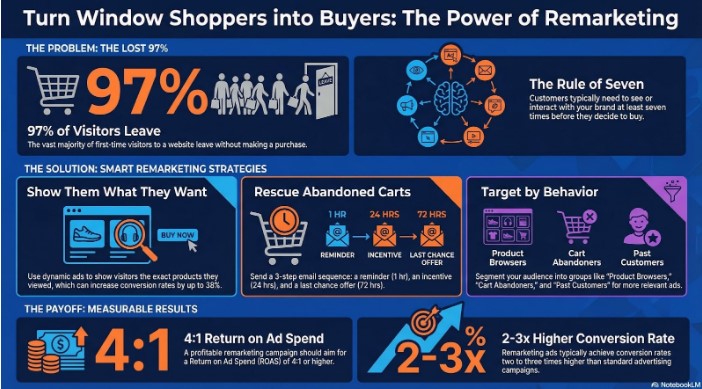
Picture this: A potential customer browses your website, checks out your products, maybe even adds something to their cart… and then disappears. Sound familiar? You’re not alone, according to business insider, 97% of first-time visitors leave without making a purchase. But here’s the good news, “those “lost” visitors aren’t really lost at all”. Confused?
It’s because of remarketing, and having correct remarketing strategies convert second chances into serious revenue. Remarketing is your digital sales team that never sleeps, gently nudging interested prospects back to complete their journey with your brand.
What Are Remarketing Strategies? Understanding the Fundamentals
Remarketing strategies are targeted marketing approaches designed to re-engage users who have previously interacted with your brand but haven’t completed a desired action. Whether they visited your website, abandoned their shopping cart, or engaged with your social media content, remarketing gives you a second (and third, and fourth or even more) opportunity to convert them.
The psychology behind remarketing is actually simple, yet powerful. According to the marketing rule of seven, customers need to encounter your brand at least seven times before making a purchase decision. Remarketing creates these essential touchpoints, building familiarity and trust that ultimately drives conversions.
Remarketing vs. Retargeting: Clearing the Confusion
While often used interchangeably, these terms have distinct differences:
- Remarketing typically focuses on digital marketing channels like performance marketing, email campaigns, sometimes Whatsapp marketing,etc. using first-party data you’ve collected
- Retargeting primarily uses cookie-based advertising to serve ads across various platforms
Both strategies complement each other beautifully in a comprehensive Digital Marketing Strategies approach.
12 Proven Remarketing Strategies That Convert
1. Dynamic Product Remarketing
Show visitors personalized ads featuring the exact products they viewed on your website. This highly targeted approach can increase conversion rates by up to 38%.
Real Example: Imagine Sarah visits an e-commerce store and spends 5 minutes looking at a specific pair of running shoes. Later, while browsing her favorite blog, she sees an ad featuring those exact shoes with a compelling headline: “Still thinking about those Nike Air Max? Get 15% off today!”
2. Cart Abandonment Email Sequences
Email Sequence | Send Time | Purpose |
Reminder Email | 1 hour after abandonment | Gentle reminder |
Incentive Email | 24 hours later | Offer discount/free shipping |
Last Chance Email | 72 hours later | Create urgency |
3. Behavioral Segmentation Remarketing
Divide your audience based on their on-site behavior:
- Product Browsers: Viewed specific categories but didn’t add to cart
- Cart Abandoners: Added products but didn’t purchase
- Past Customers: Previous buyers ready for upsells or new products
- High-Intent Visitors: Spent significant time on pricing or comparison pages
4. Cross-Platform Social Media Remarketing
Leverage platforms like Facebook, Instagram, LinkedIn, and YouTube to create a unified remarketing ecosystem. Each platform offers unique advantages for reaching different segments of your audience.
5. Video Remarketing Campaigns
With video accounting for over 65% of internet traffic, video remarketing has become increasingly powerful. Create engaging video ads that showcase your products (or services) in action or provide valuable tutorials related to your industry.
6. Search Remarketing (RLSA)
Remarketing Lists for Search Ads (RLSA) allows you to customize your search campaigns for people who have previously visited your site. This strategy can be particularly effective for businesses in competitive industries like E-Commerce, SaaS, Real Estate and more
7. Email List-Based Remarketing
Use your existing email subscriber list to create custom audiences on advertising platforms. This approach leverages first-party data, making it particularly valuable in our increasingly privacy-focused digital landscape.
8. Frequency Capping Optimization
Prevent ad fatigue by setting appropriate frequency caps. Research suggests limiting remarketing ads to 3-5 impressions per user per day to maintain effectiveness without annoying potential customers.
9. Time-Decay Remarketing
Adjust your bidding and messaging based on how recently someone visited your site:
- 0-7 days: Higher bids, direct product ads
- 8-30 days: Medium bids, brand awareness content
- 31+ days: Lower bids, educational content to rebuild interest
10. Lookalike Audience Remarketing
Create audiences similar to your website visitors or customers. This strategy helps you reach new prospects who share characteristics with your existing audience.
11. Creative Rotation and A/B Testing
Keep your remarketing ads fresh by rotating creative elements and continuously testing different versions. Test various components including:
- Ad copy and headlines
- Images and videos
- Call-to-action buttons
- Landing page experiences
12. Multi-Channel Attribution Remarketing
Implement remarketing across multiple touchpoints to create a cohesive customer journey. This approach is particularly effective for industries with longer sales cycles, such as Marketing Strategies for Food and Beverage Businesses.
Advanced Remarketing Tactics for Maximum ROI
Dynamic Creative Optimization (DCO)
DCO automatically tests and optimizes different combinations of ad elements in real-time, ensuring each user sees the most relevant version of your ad.
Predictive Remarketing
Use machine learning algorithms to identify users most likely to convert, allowing you to allocate budget more effectively and personalize messaging based on predicted behavior.
Sequential Messaging
Create a series of ads that tell a story or guide users through your sales funnel. Start with awareness-focused content and gradually move toward conversion-focused messaging.
Platform-Specific Remarketing Strategies
Google Ads Remarketing
- Display Network: Reach 90% of internet users across millions of websites
- YouTube Ads: Leverage video content for engaging remarketing campaigns
- Gmail Ads: Reach users directly in their inbox with native ad formats
Facebook & Instagram Remarketing
- Custom Audiences: Upload customer lists or use website traffic data
- Lookalike Audiences: Find new customers similar to your best existing ones
- Dynamic Product Ads: Automatically show relevant products to each user
LinkedIn Remarketing
Perfect for B2B companies, LinkedIn allows you to remarket based on professional demographics and company information.
Measuring Remarketing Success: Key Metrics That Matter
Primary KPIs
- Return on Ad Spend (ROAS): Target 4:1 or higher for profitable campaigns
- Conversion Rate: Remarketing typically achieves 2-3x higher rates than standard ads
- Click-Through Rate (CTR): Expect 2-5x higher CTRs compared to prospecting campaigns
- Cost Per Acquisition (CPA): Should be significantly lower than new customer acquisition
Advanced Analytics
Metric | What It Measures | Benchmark |
View-Through Conversions | Conversions after seeing ads | 15-25% of total conversions |
Time to Conversion | Days from first visit to purchase | Varies by industry |
Cross-Device Attribution | Multi-device customer journeys | Growing importance |
Industry-Specific Remarketing Applications
E-commerce
Focus on abandoned cart recovery and product-specific remarketing with dynamic ads showcasing exact items viewed.
SaaS/Technology
Emphasize free trials, feature demonstrations, and educational content that addresses common objections.
Real Estate
Use location-based remarketing and showcase similar properties to those initially viewed, as detailed in effective Real Estate Strategies.
Healthcare/Professional Services
Build trust through educational content and social proof, focusing on expertise and credentials.
Common Remarketing Mistakes to Avoid
1. Over-Remarketing
Bombarding users with too many ads can damage your brand reputation and waste budget.
2. Generic Messaging
Using the same ad creative for all segments reduces effectiveness significantly.
3. Ignoring Mobile Optimization
With 60% of traffic coming from mobile devices, mobile-optimized remarketing is crucial.
4. Poor Landing Page Experience
Driving remarketed traffic to irrelevant or slow-loading pages kills conversions.
5. Lack of Creative Refresh
Stale ad creative leads to banner blindness and declining performance.
Privacy-First Remarketing: Preparing for the Future
With third-party cookies being phased out, businesses must adapt their remarketing strategies:
First-Party Data Focus
Collect and leverage your own customer data through:
- Email subscriptions
- Account registrations
- Survey responses
- Purchase history
Server-Side Tracking
Implement server-side tracking solutions to maintain remarketing capabilities while respecting user privacy.
Contextual Targeting
Combine remarketing with contextual targeting based on website content rather than user behavior.
Building Your Remarketing Tech Stack
Essential Tools
- Google Analytics 4: Track user behavior and create remarketing audiences
- Facebook Pixel: Enable Facebook and Instagram remarketing
- Customer Data Platform (CDP): Unify customer data across touchpoints
- Email Marketing Platform: Execute email-based remarketing campaigns
- Creative Management Platform: Optimize and scale ad creative production
Advanced Integrations
Consider integrating your remarketing efforts with other marketing channels, such as Different Types of PPC Ads, to create a cohesive omnichannel experience.
Setting Up Your First Remarketing Campaign: Step-by-Step Guide
Phase 1: Foundation Setup (Week 1)
- Install tracking pixels on all relevant pages
- Set up conversion tracking
- Create basic audience segments
- Develop initial creative assets
Phase 2: Campaign Launch (Week 2)
- Launch with one platform (recommend starting with Google or Facebook)
- Begin with simple remarketing lists
- Set conservative budgets and frequency caps
- Monitor performance closely
Phase 3: Optimization (Weeks 3-4)
- Analyze performance data
- Adjust bidding strategies
- Expand to additional platforms
- Test new creative variations
Phase 4: Scale (Month 2+)
- Increase budgets for winning campaigns
- Add advanced remarketing tactics
- Implement cross-platform attribution
- Develop seasonal campaign variations
The Future of Remarketing Strategies
2026 Trends to Watch
- AI-Powered Personalization: Machine learning will enable hyper-personalized remarketing at scale
- Voice and Audio Remarketing: As smart speakers proliferate, audio remarketing will emerge
- Augmented Reality (AR) Integration: Interactive AR ads will provide immersive remarketing experiences
- Predictive Analytics: Advanced algorithms will predict optimal remarketing timing and messaging
Preparing Your Strategy
Stay ahead by:
- Investing in first-party data collection
- Testing emerging platforms and formats
- Building flexible, privacy-compliant systems
- Focusing on customer experience over pure conversion metrics
Conclusion: Your Remarketing Success Roadmap
Remarketing isn’t just about getting a second chance – it’s about maximizing the value of every visitor who shows interest in your brand. By implementing the strategies outlined in this guide, you’ll be well-equipped to turn those “lost” visitors into loyal customers.
Remember, successful remarketing is part art, part science. Start with the fundamentals, test continuously, and always prioritize user experience over aggressive selling. With the right approach, remarketing can become your most profitable marketing channel, delivering consistent results while building stronger relationships with your audience.
The digital landscape continues to evolve, but one thing remains constant: people need multiple touchpoints before making purchase decisions. Remarketing strategies ensure you’re present at each crucial moment, guiding prospects toward conversion while providing genuine value along the way.
Ready to transform your marketing results? Start implementing these remarketing strategies today, and watch your conversion rates soar.